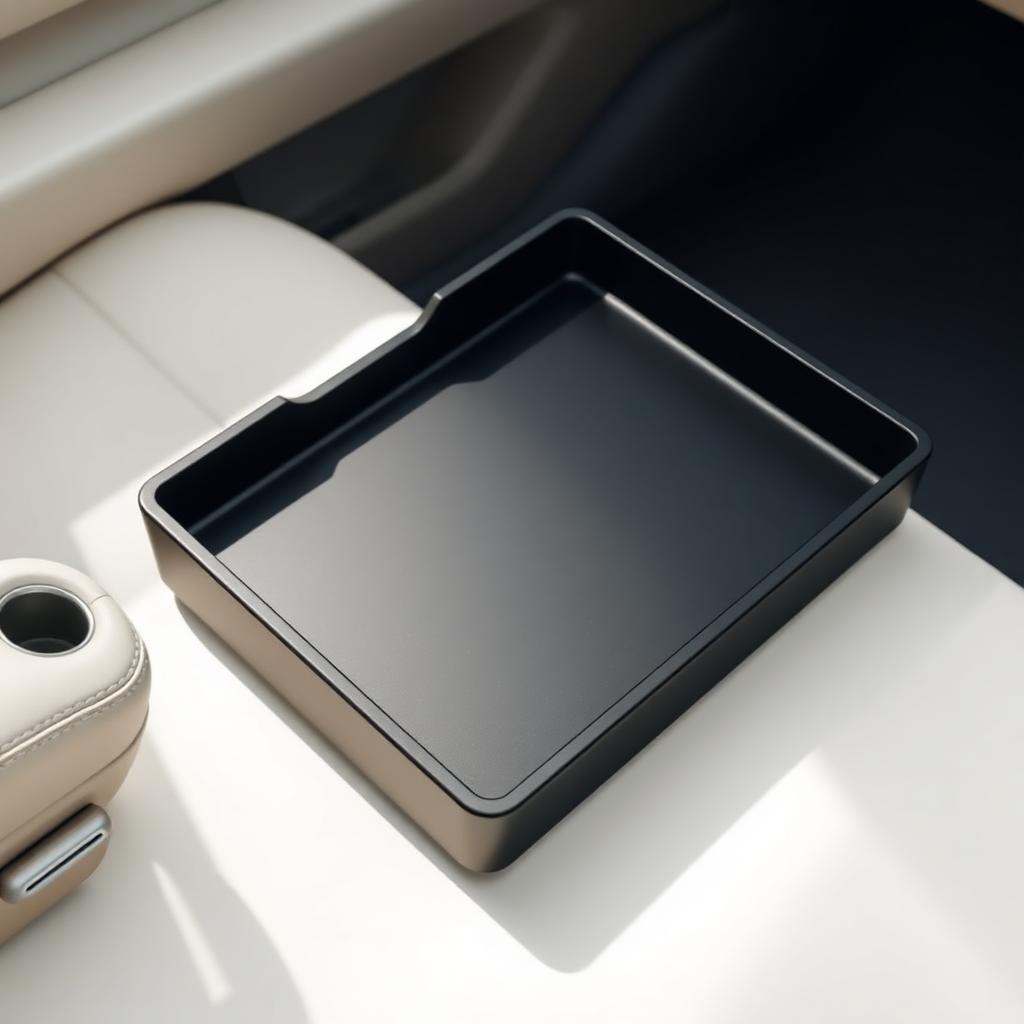
Tesla interiors are designed around empty volume. Deep console wells, an open frunk tub and a two-level trunk give a lot of usable space with almost no structure inside it, so items settle wherever the last corner sent them. Organisation accessories exist to add that structure back.
The risk is that an insert can subtract space instead of shaping it. A tray that halves the depth of a well, or a divider set that has to be lifted out before the groceries fit, replaces one annoyance with another. This guide works through each storage area in turn and asks a single question of every product: does it reduce the number of times you reach, search or reshuffle?
Start with the items, not the compartments
Interior organisation goes wrong when it begins with the car. Beginning with the objects is more reliable: list what actually travels in the cabin and how often each item is needed. Sunglasses, a charging cable, a parking card and a small cleaning cloth are daily-reach items. A tyre repair kit, a first-aid pouch and a spare adapter are once-a-season items.
Daily-reach items belong in shallow, visible places within arm's length of the driver. Season items belong in the deepest storage you have, ideally in a closed bag rather than a fixed divider. Almost every organisation mistake comes from putting one category in the other's place.
- Daily reach — shallow, open, close to the driver, easy to clean out.
- Weekly reach — inside the console or the door bins, contained but not visible.
- Rare or emergency — frunk or under-floor storage, in a bag you can lift out whole.
Center console: shape the depth, do not fill it
The console is where small items disappear. A single deep well swallows keys, cables and coins, and everything slides forward under braking. A tray insert that sits at the top of the well is usually the higher-value part: it holds the daily items at a visible level and leaves the space below for anything taller.
Full-depth divider sets are the opposite trade. They create tidy compartments, but each compartment is smaller than the thing you eventually want to store, and the whole assembly has to come out to clean under it. If the console mainly carries a phone, a cable and a card, a tray plus a small non-slip liner is often the complete answer.
Consoles differ substantially by model and revision — wireless charging pads, sliding lids, cup-holder geometry and rear console vents have all changed across production. Buy against the specific interior your car has, not the model name alone.
- A removable tray is easier to clean than fixed dividers and can be lifted out when you need the full depth.
- Non-slip lining matters more than compartment count; noise usually comes from hard plastic on hard plastic.
- Check whether the insert blocks a charging pad, a lid track or a rear vent before ordering.
- Cup-holder inserts are worth it only if you actually store small items there rather than drinks.
Related accessories
Frunk: a place for things you rarely open
The frunk is the natural home for items that should not share space with passengers or shopping: charging adapters, a spill kit, cleaning supplies, a compact tool roll. Its shape is a tub with sloped walls, so unsecured items travel and the lid gives no help holding them in place.
Two approaches work. A soft, collapsible organiser with a stiff base keeps a group of items upright and can be lifted out as one unit. A fitted liner or tray does less for containment but protects the surface and makes it easy to wipe out after carrying anything damp. Frunk volume and depth vary by model and by production year, and some vehicles have a shallower tub than the model's older versions, so the internal dimensions are the number to check.
- Prefer an organiser you can remove whole rather than a fixed set of walls.
- A stiff base stops a soft bag from folding when it is only half full.
- Confirm the lid still closes with the organiser loaded, especially on shallower frunks.
- Keep anything that can leak in a sealed pouch; the frunk drains are not a cleaning plan.
Trunk and cargo: containment beats compartments
Cargo problems are rarely about capacity. They are about loose items sliding across a wide, smooth floor, and about the under-floor well being awkward to reach once the main area is loaded. The useful accessory here is one that holds a group of things still and can be collapsed when you need the whole floor.
A folding crate or divider that stands up under load handles the weekly shop; a rigid box that cannot fold will end up stored in the garage. If the under-floor compartment holds items you need regularly, move them: anything you have to unload the trunk to reach is stored in the wrong place.
Seat configuration changes this area completely. Five-seat and seven-seat cars have different rear floors, well depths and cover arrangements, so cargo inserts are not interchangeable between them, and load-floor accessories cut for one model year may sit proud on another.
- Folding or collapsible, so the full floor is still available when you need it.
- Grippy base or side retention — a crate that slides is only a smaller version of the same problem.
- Sized to leave the under-floor lid openable without unloading everything above it.
- Wipe-clean material if wet gear, sports kit or garden waste is part of normal use.
Related accessories
Cleaning access is part of the design
Interior storage collects dust, crumbs and grit faster than any other part of the cabin, and an organiser that cannot be removed quickly tends to stay dirty. The practical test is whether the item lifts out in one motion, without tools and without emptying it first.
Adhesive-mounted accessories deserve particular caution. They are difficult to reposition, they can mark soft-touch trim, and they remove the option of taking the part out to wash it. Where a friction fit or a weighted base will do the job, that is the lower-risk choice.
- Removable without tools, and light enough to lift out when loaded.
- Washable rather than only wipeable, for anything holding food, damp gear or footwear.
- Avoid adhesive on visible trim unless there is no alternative fixing.
Capacity versus accessibility
Every organiser trades one against the other. Dividers raise accessibility and lower usable volume; a single deep bin does the reverse. The right balance depends on how the space is used rather than on how tidy it looks in a product photograph.
A reasonable default: keep accessibility high where you reach several times a day, and capacity high where you reach a few times a month. Applying that consistently means the console gets a shallow tray, the frunk gets one liftable bag, and the trunk gets containment that folds away.
Fitment details worth checking first
- Model and model year — console shape, frunk depth and load-floor height have all changed across revisions.
- Interior revision — a mid-cycle interior update can move charging pads, lids and vents even within the same model.
- Seat configuration — five- and seven-seat cargo floors differ; inserts are not interchangeable.
- Left- or right-hand drive — console geometry and reach distances are mirrored, which affects tray layouts.
- Whether the accessory obstructs a lid, a vent, a charging surface or a cargo cover when loaded.
Common buying mistakes
- Buying a full divider kit before knowing which items actually live in the console.
- Choosing rigid cargo boxes that cannot fold, then storing them at home.
- Filling every compartment, which turns storage into a place things are lost rather than found.
- Ignoring cleaning access and ending up with an organiser that is never taken out.
- Duplicating storage the car already provides — door bins and under-seat space are often enough for the same items.
When an organizer is unnecessary
If the cabin already stays tidy, an insert adds weight and a cleaning task without solving anything. Short commutes with few carried items, a car used mainly solo, or a household that unloads the trunk after every trip rarely need much beyond a non-slip liner.
Two low-cost measures solve a surprising share of interior clutter before any insert is considered: a rubber liner in the console well to stop sliding and noise, and one soft bag in the frunk for the items that only appear in an emergency.
Related guides
A short decision framework
- Name the problem — sliding, searching, protecting or containing. If none applies, skip the purchase.
- Match the storage area to how often you reach for the item.
- Prefer removable and collapsible over fixed and rigid.
- Check the fitment details for your model year, interior revision and seat layout.
- Buy one item, use it for a few weeks, then decide whether a second is genuinely needed.
Console trays, inserts and rear-seat storage
The console bin is the one space in a Tesla that fills itself. Left empty it becomes a single deep well where small items settle at the bottom, which is why tray-and-insert arrangements are the most-bought organisation product in the range.
There are two design philosophies. Sliding organisers keep the full bin volume and move a tray across it, so you retain depth for larger items. Fixed trays divide the space permanently, which suits owners who carry the same handful of small things every day. Neither is better; they reflect whether you value depth or division.
Rear passengers are the group most often left out of interior organisation. A vent-area organiser gives the back seats somewhere to put a phone that is not the seat beside them, which is a small change with a disproportionate effect on how tidy the car stays.
Conclusion
Good interior organisation in a Tesla is mostly subtraction: fewer loose items, fewer places where things can slide, and storage that matches how often you actually reach for something. One tray, one liftable frunk bag and one folding cargo container cover the majority of real use.
Check the insert against your specific interior before ordering, favour parts that come out for cleaning in a single motion, and leave the remaining compartments empty until a genuine need appears.
More guides
- Best Tesla Accessories for Model 3 & Model Y
- Tesla Model Y Juniper Accessories Worth Buying First
- Tesla Model Y Accessories: The Complete Buyer's Guide
- Best Floor Mats for Tesla Model Y: How to Choose
- Tesla Model 3 Accessories Worth Buying First
- Tesla Charging at Home: Cables, Holders and Setup
- Tesla Dashcam and Sentry Mode Storage Explained
- Tesla Winter Driving: Protection and Cabin Gear
- How to Check Tesla Accessory Fitment by Model and Year
- Tesla Road Trip Accessories: What to Pack and What to Skip
- Tesla Pet Travel Accessories: A Practical Guide for Dogs and Cats
- Tesla Model Y Adapter Guide: J1772, NACS & Charging Adapters
- 2026 Tesla Model 3 16-Inch Screen: Fitment Guide
- Tesla Model Y Cabin Air Filter: HEPA Replacement Guide
- Tesla Jack Pads and Lifting Pucks: Fitment and Safe Use
- Tesla Model Y Sunshade Guide: Windscreen and Glass Roof
- Tesla Model Y Mattress Guide: Camping and Sleeping Setup
- Tesla Model Y Fridge and Cooler Guide: Frunk, Console and Trunk
- Tesla USB Hub and Cabin Charging Guide: Model Y and Model 3
- Tesla Model S and Model X Accessories: Protection and Shading
- Tesla Cybertruck Bed Mat Guide: Protecting the Vault
- Tesla Model 3 Highland Floor Mats and Interior Protection