Planning a longer drive tends to expand a shopping list. A trip introduces unfamiliar situations, and unfamiliar situations invite pre-emptive buying: a holder for the cable, a container for the trunk, a mount for the phone, a kit for the mess that has not happened yet. Much of it can end up unused in a bag under the parcel shelf.
This guide is about the decision rather than the products. It looks at what genuinely changes when an accessory is used away from home, offers a way to filter categories against your own trip, and is explicit about the cases where the sensible answer is to take nothing extra at all. What applies to your car depends on the model, model year, configuration, market and how you travel, so treat every category below as conditional.
What changes when an accessory travels
At home an accessory can be adjusted, cleaned or ignored. On a trip it is used repeatedly, in the dark, in poor weather, with passengers waiting and luggage in the way. That shifts which qualities matter: setup time, whether it can be stowed with one hand, whether it stays put over rough surfaces, and whether it still works when the compartment it lives in is full.
It also changes the cost of getting it wrong. An item that is mildly awkward on a commute can become the thing that has to be unpacked at every stop. The useful test before packing anything is not whether it is good, but whether it survives repetition.
- Frequency — an item touched several times a day needs to live within reach, not in the trunk.
- Setup cost — anything requiring assembly at each stop tends to stop being used by the second day.
- Stowage — a container that does not collapse or nest takes space for the whole journey.
- Shared use — with passengers, an accessory that only works from the driver's seat solves half the problem.
A road-trip decision framework
Rather than sorting products into essential and non-essential, it is more reliable to describe the trip first and let the categories follow. Four variables do most of the work: how long you are away, who is travelling, how luggage moves, and where you expect to charge.
Run each candidate accessory through the same four questions. If a category survives all four, it is probably worth packing for this particular trip; if it fails one, it can usually stay at home without consequence.
- Which specific trip problem does it solve — not a general one?
- Has that problem actually occurred on comparable drives, or is it hypothetical?
- Does the car, or something you already own, handle it adequately?
- What does carrying it cost in space, setup and things to keep track of?
Cable and connector organisation
A loose charging cable in the trunk is a travel problem rather than a storage one: it is handled in car parks, sometimes wet, often at night, and then put back among soft luggage. A bag or wrap can make the difference between a cable that lives in one place and one that is dug out from under bags at every stop.
This matters more when public charging is frequent, and much less on a trip where the car is charged at the destination and rarely elsewhere. Which cables you carry, and whether any are needed at all, depends on the vehicle, its market and the connector types available on your route.
- Consider it if — you charge away from home several times per trip, or the cable shares space with luggage.
- Check before buying — that the bag or wrap suits the length and connector shape of the cable you actually carry.
- Trade-off — an enclosed bag keeps dirt off the luggage but adds a step when the cable is damp and needs to dry.
- Skip it if — the cable stays in one compartment and is used rarely on the journey.
Related accessories
Related guides
Phone mounting and visibility
The car's own display handles navigation, so a phone mount is worth considering only where the phone is doing a job the screen is not: a second route view, a passenger managing stops, live messages while a co-driver navigates, or a phone used for work calls on a long stint.
Where a mount does earn its place, position matters more than the mounting mechanism. Anything that intrudes on the driver's view or blocks a vent is worse than no mount. Mount compatibility depends on the interior revision, trim shape and available anchor points, so check the specific mounting surface in your car rather than the model name on the listing.
- Consider it if — a phone is used actively while driving by you or a passenger.
- Check before buying — the exact anchor point (vent, panel edge, screen surround) and whether it exists in your car's interior revision.
- Trade-off — a very secure mount can be slow to release at charging stops; a quick-release one may hold less firmly on rough roads.
- Skip it if — navigation runs on the car's display and the phone stays in a pocket or tray.
Related accessories
Cabin organisation for the things used hourly
On a long drive a small set of items is handled constantly: cards, sunglasses, chargers, snacks, tickets, a document or two. If they live in a deep undivided well they migrate to the seats and door pockets within a few hours, and the search for them happens at exactly the wrong moments.
A shallow tray or divided insert is a modest change with a visible effect here, and it is one of the few travel accessories that also earns its place afterwards. Console architecture has varied between models and interior revisions, so a tray should be matched to your car's specific console rather than to its badge.
- Consider it if — several small items are used repeatedly and currently have no fixed place.
- Check before buying — console shape and depth for your model year and interior revision.
- Trade-off — a divided insert reduces total capacity in exchange for making items findable.
- Skip it if — the cabin already stays tidy on shorter drives.
Related accessories
Related guides
Containment in the trunk and frunk
Travel luggage is usually well behaved; the loose items around it are not. Bottles, chargers, shoes, shopping picked up en route and the bag that holds the cable all move when the load shifts, and each stop becomes a repack.
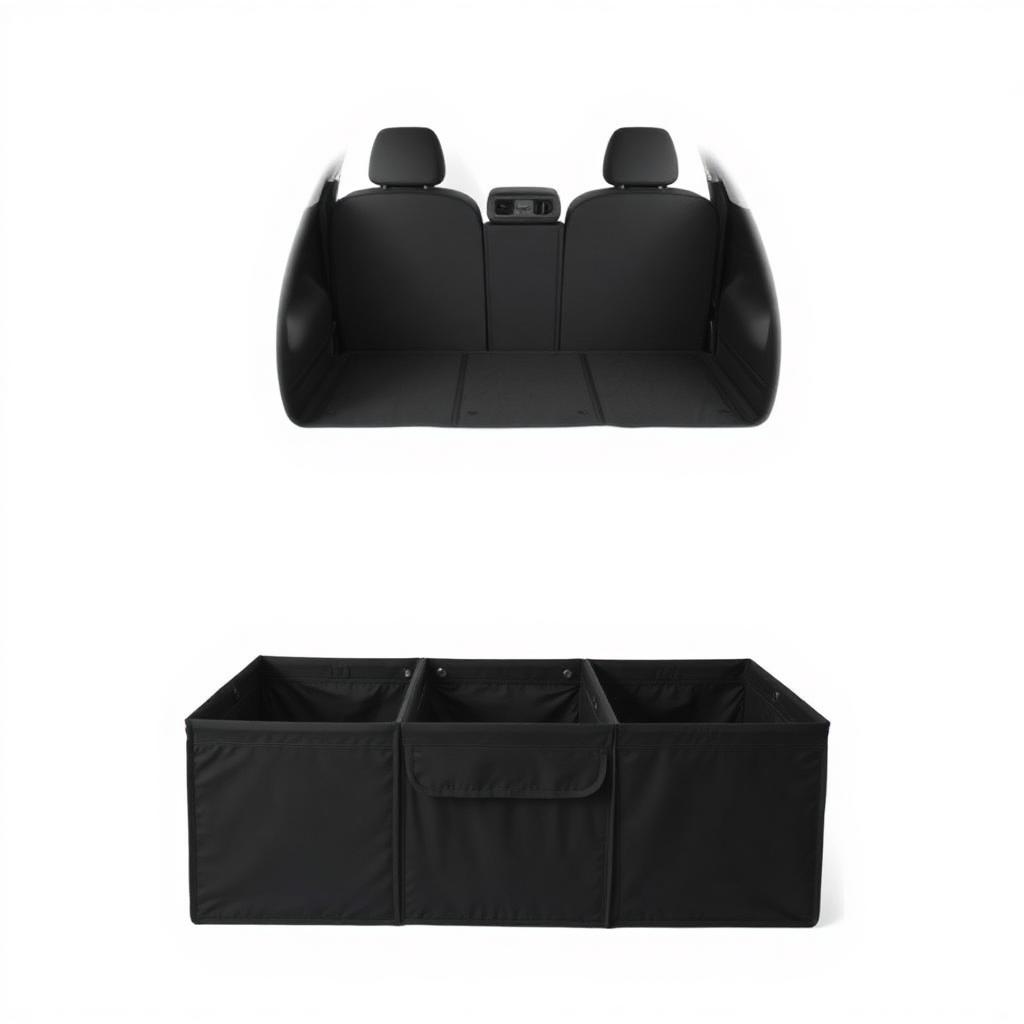
A collapsible container or a single soft bag in the frunk separates the items that are needed at every stop from the ones opened only at the destination. This is worth more on trips with several stops than on a single long run, and the useful dimensions depend on the well shape of your specific model and configuration.
- Consider it if — luggage is unpacked and repacked at intermediate stops, or small items travel loose.
- Check before buying — the depth and narrowest width of the well in your car, not the published capacity alone.
- Trade-off — rigid containers hold shape but take space when empty; folding ones stow away but hold less firmly.
- Skip it if — the load fills the compartment anyway and nothing moves.
Related accessories
Charging-related items for the road
What is useful here is highly specific to the car and the region. Connector types, supported charging options and any adapters that may be relevant differ by model, model year and market, and by what is installed on the routes you plan to use. Confirm what your vehicle supports from its own documentation before buying anything that claims a charging role.
Two things are worth thinking about regardless of the hardware: where the cable lives while travelling, and how much of the trip's charging will be at a destination rather than en route. A trip charged mainly overnight at accommodation places very different demands on packing than one charged repeatedly in transit.
- Consider it if — the route relies on charging away from home and the vehicle's supported options are confirmed.
- Check before buying — connector type, market variation and what your specific configuration supports.
- Trade-off — carrying more charging hardware than the route requires adds weight and clutter for the whole journey.
- Skip it if — charging happens at the destination and the standard arrangement already covers it.
Related accessories
Related guides
Cleaning and protection that make sense in transit
Interior wear accelerates on trips because dirt is brought in from unfamiliar places and stays there for days. A small cleaning kit is useful mainly for glass, the display surround and spills that would otherwise set; the full cleaning routine belongs at home.
Floor protection is worth thinking about before departure rather than during it. All-weather mats are relevant where wet or muddy conditions are likely; on a dry summer trip they solve little that a shake-out at the destination would not. Mat fitment depends on footwell shape, anchor position, drive side and seat layout, so verify the set against your car if you are buying for the trip.
- Consider it if — wet, sandy or muddy conditions are likely, or the car will carry pets or children for several days.
- Check before buying — coverage and retention details for your model, drive side and seat configuration.
- Trade-off — a larger kit covers more situations but occupies space that luggage may need.
- Skip it if — the trip is short, dry and ends where proper cleaning is available.
Related accessories
Related guides
Preparedness items, kept proportionate
Basic preparedness is reasonable on a long drive: a light, something warm, water, and whatever your region's regulations require you to carry. These are travel items rather than vehicle accessories, and they are the part of the list least likely to be regretted because they take little space.
The proportion matters. Preparedness expands easily into equipment for scenarios that a mapped route with charging stops is unlikely to produce, and each addition takes space from the things used daily. If recording matters to you on unfamiliar roads, that is a separate question about storage and setup rather than an emergency one.
- Consider it if — the route includes remote sections, night driving or seasonal weather risk.
- Check before buying — any items your market requires drivers to carry.
- Trade-off — every additional contingency item competes with luggage space.
- Skip it if — it duplicates something already in the car or in a bag you are taking anyway.
Related guides
Usually optional rather than essential
Several popular travel purchases sit in a middle band: genuinely pleasant, occasionally useful, rarely decisive. They are worth buying when a specific trip calls for them and worth leaving when it does not.
- Rear-seat entertainment holders — relevant with children on long stints, redundant otherwise.
- Additional charging pads or hubs beyond the ports already used by passengers.
- Sunshades and privacy screens, where the trip involves sleeping in the car or long parked periods.
- Duplicate cables kept as spares, which are cheap insurance but easy to accumulate.
- Seat-back organisers, useful with passengers and simply extra bulk when travelling alone.
What to skip
The clearest candidates for leaving behind are items that add bulk without removing a task, duplicate something the vehicle already handles, need setting up each time, or address a problem that has not happened on comparable drives.
- Anything that must be assembled or repositioned at every stop.
- Accessories that duplicate a function the car's own systems or storage already cover adequately.
- Large rigid containers bought for a single trip, which then travel empty on the way home.
- Products chosen on a model name alone, without checking the fit point for your configuration.
- Bundles that include several items to obtain one, leaving the remainder in the trunk.
- Anything bought in the final days before departure to solve a problem you have not yet encountered.
Related guides
Choosing by trip profile
The same category can be sensible or pointless depending on the shape of the journey. Reading your own trip honestly removes more items than any product comparison.
- Trip length — one long run rewards cabin organisation; multi-stop routes reward containment and cable handling.
- Passengers — shared use shifts value towards rear access, second charging points and seat-back storage.
- Luggage behaviour — if bags move between compartments during the trip, containment matters; if they are loaded once, it does not.
- Charging pattern — frequent en-route charging raises the value of cable organisation; destination charging lowers it.
- Destination conditions — wet, sandy or cold conditions move protection up the list.
- Frequency — for one trip a year, borrowing or improvising is often the better answer than buying.
A pre-trip checklist
- List the items you will reach for more than twice a day and give each a fixed place within reach.
- Decide where the charging cable lives, and whether anything is needed to keep it separate from luggage.
- Confirm what your specific vehicle and market support before buying anything charging-related.
- Check any new accessory against your model, model year, interior revision, drive side and seat layout.
- Load the trunk once at home to see whether a container is genuinely needed.
- Remove anything from the list that has not been used on a comparable previous drive.
- Keep required documents and regional obligations in one accessible place.
When no additional accessories are needed
Plenty of long trips need nothing beyond what the car already provides. A journey with one or two occupants, luggage loaded once, charging arranged at the destination and dry conditions on arrival rarely produces the problems these products solve.
If the last comparable drive passed without irritation, that is the strongest available evidence. Travelling once without buying anything and noting the two or three moments that were genuinely awkward is a better basis for a purchase than a pre-trip list written in advance.
Sleeping in the car, cold storage and the one tool worth carrying
Longer trips push three categories from optional to useful. The first is sleeping: with the rear seats folded, a shaped mattress turns a Model Y boot into an occasional bed, which changes how you plan a long drive rather than merely making it more comfortable.
The second is cold storage. A portable fridge in the frunk, or a small unit fitted into the rear console or side recess, removes the daily hunt for somewhere to buy a cold drink. Which one suits you is a question of where it will physically sit, not of capacity.
The third is a jump starter. It is not for the traction battery — it is for the 12 V system, and it is equally useful for other people's cars at a trailhead where there is nobody else around. It is the one piece of emergency kit that earns its boot space on trips far from help.
Related accessories
Conclusion
Road-trip accessory buying goes wrong when the trip is imagined rather than described. Once the length, passengers, luggage pattern, charging habits and destination conditions are written down, a large part of the list answers itself, and what remains is usually two or three items that remove a repeated task.
Where an item does earn a place, confirm it against your exact vehicle and configuration before ordering rather than relying on a model name, and be willing to conclude that this particular trip needs nothing new at all.
More guides
- Best Tesla Accessories for Model 3 & Model Y
- Tesla Model Y Juniper Accessories Worth Buying First
- Tesla Model Y Accessories: The Complete Buyer's Guide
- Best Floor Mats for Tesla Model Y: How to Choose
- Tesla Model 3 Accessories Worth Buying First
- Tesla Charging at Home: Cables, Holders and Setup
- Tesla Dashcam and Sentry Mode Storage Explained
- Tesla Winter Driving: Protection and Cabin Gear
- Tesla Interior Organization: Console, Frunk and Trunk
- How to Check Tesla Accessory Fitment by Model and Year
- Tesla Pet Travel Accessories: A Practical Guide for Dogs and Cats
- Tesla Model Y Adapter Guide: J1772, NACS & Charging Adapters
- 2026 Tesla Model 3 16-Inch Screen: Fitment Guide
- Tesla Model Y Cabin Air Filter: HEPA Replacement Guide
- Tesla Jack Pads and Lifting Pucks: Fitment and Safe Use
- Tesla Model Y Sunshade Guide: Windscreen and Glass Roof
- Tesla Model Y Mattress Guide: Camping and Sleeping Setup
- Tesla Model Y Fridge and Cooler Guide: Frunk, Console and Trunk
- Tesla USB Hub and Cabin Charging Guide: Model Y and Model 3
- Tesla Model S and Model X Accessories: Protection and Shading
- Tesla Cybertruck Bed Mat Guide: Protecting the Vault
- Tesla Model 3 Highland Floor Mats and Interior Protection