Short answer
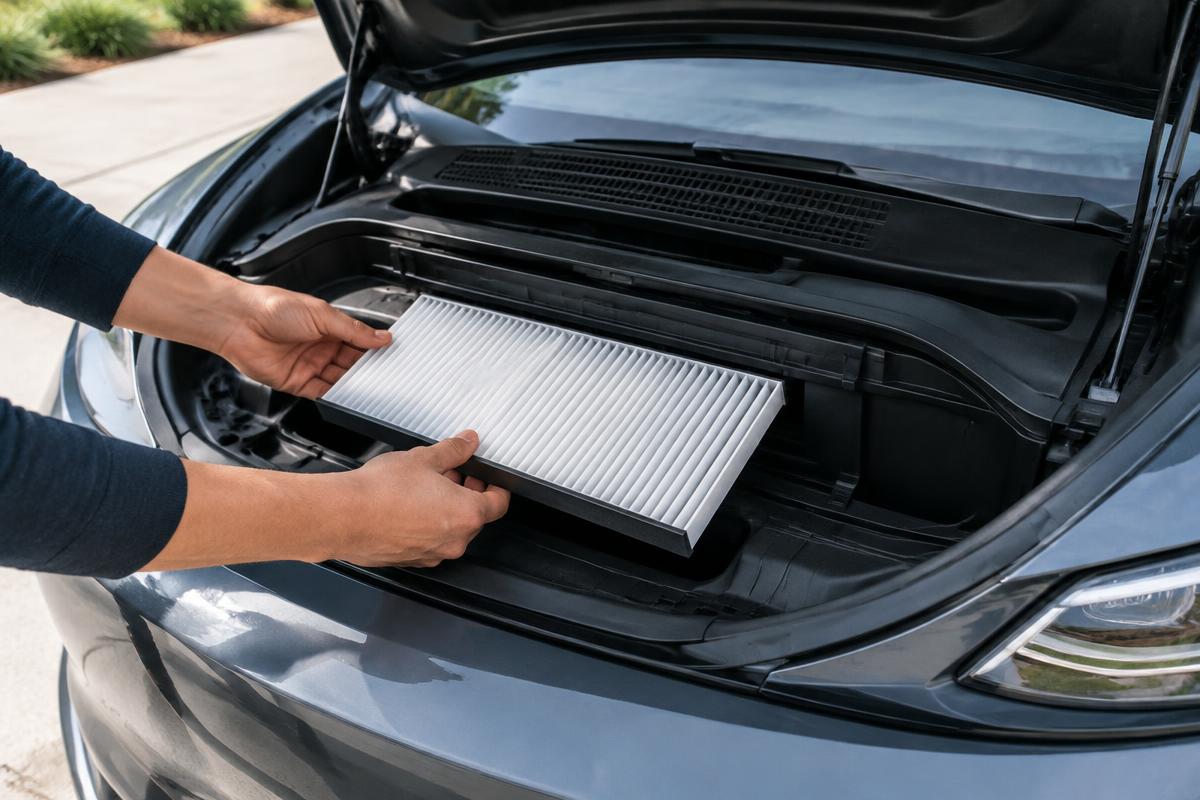
The Tesla Model Y cabin air filter sits in the intake channel beneath the frunk liner, not behind the glovebox, which is why it is one of the few genuinely DIY jobs on the car. Most owners change it in about fifteen minutes with a trim pick.
A Model Y filter set is usually two elements per side: a particulate layer, often described as HEPA-grade, and an activated carbon layer that handles smells rather than dust.
The single most important thing on any Model Y cabin air filter listing is the fitment note. Sets sold as covering 2020-2026 commonly exclude the 2021 Model Y Long Range RWD, and that exclusion appears across multiple sellers.
Fitment snapshot
- Vehicle
- Tesla Model Y, including the 2025-2026 Juniper refresh
- Filter location
- Intake channel beneath the frunk liner
- Common exclusion
- 2021 Model Y Long Range RWD is excluded by several sellers in this category
- Source of fitment claims
- Seller listing statements, recorded against each product in the EV Gear Lab catalogue
What to check before buying
- Confirm your exact Model Y variant and build year against the listing, including the 2021 Long Range RWD exclusion.
- Check whether the pack is four identical panels or a mixed HEPA and carbon set, because fitting order differs.
- Buy a Model Y part number: Model 3 filters are a different shape and will not seal correctly.
- Treat a four-pack as two complete changes rather than one, and store the spare pair flat and dry.
- Price and stock live on Amazon. EV Gear Lab does not publish prices or ratings.
Last reviewed by EV Gear Lab on September 23, 2026. Fitment statements come from the compatibility records stored for each product; assessments are EV Gear Lab editorial judgement and are kept separate from manufacturer and marketplace listing claims.
Cabin air filtration is the least glamorous maintenance item on a Tesla Model Y and one of the few that owners can genuinely feel. It does not show up as a warning, it does not degrade suddenly, and nothing on the touchscreen tells you it has stopped doing its job. Instead it fades: the fan gets louder for the same amount of airflow, the windscreen takes longer to clear, and the first thirty seconds of the climate system start to smell faintly of wherever the car last sat.
The good news is that the Model Y makes this easy. Where many cars bury the cabin filter behind a dismantled glovebox, Tesla put the Model Y intake filters in a channel at the base of the windscreen, reachable from the frunk. There is no trim to break, no fasteners to lose inside a dashboard, and no real chance of doing damage.
This guide covers where the filter sits, what the layers actually do, how to choose between the sets available, the fitment exclusion that trips people up, and how to do the change without guessing.
What the Model Y cabin filter actually does
Air for the cabin is drawn in at the base of the windscreen, passes through the filter stack, then reaches the blower and the vents. Everything the car breathes goes through that stack first, which means the filter is simultaneously the cabin's defence and its bottleneck.
Two different jobs happen in that stack. A particulate layer, usually described as HEPA-grade and often electrostatically charged, captures solid matter: pollen, road dust, the fine particulate thrown up by braking traffic. An activated carbon layer handles the gaseous side: exhaust, fuel vapour, agricultural smells, the diesel van in front of you at the lights. Carbon does nothing for dust and the particulate layer does nothing for smell, which is why most sets include both.
Both layers degrade differently, and that matters when judging whether yours needs replacing. The particulate layer fails visibly and mechanically: it loads up, airflow drops, the fan works harder. The carbon layer fails invisibly, because its capacity is chemically finite. A carbon element can look clean and still have nothing left to give.
- Particulate layer: pollen, dust, brake and road grit. Failure shows as reduced airflow.
- Activated carbon layer: odours and gaseous compounds. Failure shows as smells returning.
- Neither layer cleans air already inside the cabin.
- Neither layer is a substitute for factory high-efficiency filtration hardware.
How to tell yours is due
Tesla publishes a recommended interval in the owner's manual for your specific car, and that is the number to work to. In practice, owners tend to notice the symptoms before the calendar reminds them.
The most reliable indicator is airflow at a fixed fan speed. If the setting you have always used no longer clears the windscreen as quickly, or you find yourself nudging the fan up one step as a matter of habit, the stack is loading. The second indicator is the first thirty seconds of the climate system after the car has been parked: a musty note there almost always means the carbon layer is spent or the intake has collected damp leaf matter.
The third indicator is simply looking. Pull the old filters and hold them up. A filter that has gone from white to grey-brown across its whole face, or that has visible seed casings and leaf fragments in the pleats, has done its work.
Choosing between the sets
There is less to choose between Model Y filter sets than the listings suggest, because they are all replacing the same part in the same channel. The meaningful differences are the layer arrangement, the rigidity of the frame, and how specific the fitment statement is.
Layer arrangement matters for fitting order. A four-pack of identical combination panels goes in without thought. A mixed set of two HEPA and two carbon elements has to go in the order the seller specifies, and getting it wrong does not break anything but does change what the stack does.
Frame rigidity matters over time. A soft paper surround can soften and bow slightly in a humid summer, and a bowed filter opens a small bypass along one edge — air taking the easy route around the media rather than through it. A moulded or honeycomb frame resists that.
Model Y cabin filter sets in this catalogue
The fitment exclusion to check before ordering
Almost every Model Y filter listing worth considering states coverage from 2020 through 2026, and several now state the 2025-2026 Juniper refresh explicitly. That is a wide window for a shaped part, and it holds because the intake channel did not change in the ways that matter.
There is one recurring exception, and it is specific: the 2021 Model Y Long Range RWD. Multiple independent sellers exclude that variant by name. When several unrelated listings carry the same exclusion, it is usually describing a genuine difference in that build rather than one cautious seller.
If your car is that variant, do not order on the assumption that close enough will seal. A filter that does not fill the channel is a filter that air goes around.
- Confirm model year and drivetrain variant, not just Model Y.
- Confirm the listing states your year explicitly rather than implying it.
- Juniper owners: look for 2025-2026 stated, not inferred from a 2020+ claim.
- Do not substitute a Model 3 filter — it is a different shape.
Related guides
Doing the change
The job is short enough that most owners do it in the driveway. Open the frunk and lift out the frunk liner, which is held by clips rather than fasteners. Beneath it, at the base of the windscreen, is a plastic cover over the intake channel; this comes away with a trim pick or a firm pull at the clip points.
Before removing anything, photograph the old filters in place. That single photograph settles the two questions people ask afterwards: which way the airflow arrows pointed, and which element sat in front.
Withdraw the old filters upward. They are often dirtier than expected and will shed debris, so have something to put them in. Vacuum any leaf matter out of the empty channel — this is the one opportunity you get, and a channel full of decomposing leaves will smell through a brand new filter.
Slide the new elements in with the arrows matching, refit the cover until the clips seat, and replace the liner. Run the fan at a high setting for a minute afterwards and listen: the note should be cleaner and the airflow noticeably stronger.
- Photograph the old filters before removing them.
- Vacuum the empty intake channel while you have access.
- Match the airflow arrows to the parts you removed.
- Check the cover clips are fully seated before refitting the liner.
- Keep the spare pair from a four-pack flat and dry for the next change.
Common mistakes
- Buying a Model 3 filter for a Model Y because the price looked better.
- Missing the 2021 Long Range RWD exclusion and forcing a part that will not seal.
- Fitting a mixed HEPA and carbon set in the wrong order.
- Ignoring the airflow direction arrows.
- Expecting a filter change to fix a smell whose source is inside the cabin.
- Storing the spare pair folded in a boot bin, which deforms the media.
Related Tesla models
Conclusion
A cabin filter change is the highest return-per-minute maintenance job on a Model Y. Fifteen minutes, no tools of consequence, and an immediate, audible difference in how the climate system behaves.
The only part that requires care is the ordering. Confirm your variant against the listing exclusion, buy a Model Y part number rather than a near-match, and treat a four-pack as two changes. Do that and the rest of the job is genuinely difficult to get wrong.
Frequently asked questions
Where is the cabin air filter on a Tesla Model Y?
In the air intake channel under the frunk liner, at the base of the windscreen. It is reached from the frunk rather than from inside the cabin.
How often should a Model Y cabin filter be changed?
Tesla publishes a recommended replacement interval in the owner's manual for your car, and that manual is the figure to follow. Owners in dusty, pollen-heavy or heavy-traffic environments often change theirs sooner because airflow drops noticeably first.
Does a new cabin filter remove a smell from the car?
Only if the smell is entering through the intake. If the source is damp carpet, spilled liquid or the evaporator, a new filter will not fix it, and the smell returning quickly after a change is the clue.
Do Model Y filters fit the 2025-2026 Juniper?
Several sets state coverage through 2026 including Juniper, but this has to come from the listing rather than from assumption. Both filter sets in this catalogue carry that stated coverage.
Is a HEPA cabin filter the same as Tesla's HEPA filtration option?
No. A replacement intake filter is a service part. It is not the same as the factory high-efficiency filtration hardware offered on some Tesla models, and fitting one does not add that feature to a car that was not built with it.
Which way round does the filter go?
Airflow arrows on the filter edge must point the same way as the parts you removed. Photograph the old filters before withdrawing them if you are unsure.
How EV Gear Lab works: we research Tesla and EV accessories, record the fitment each product states, and publish our own assessment of how useful it is. Fitment and specification statements come from the product's stored record and the manufacturer listing; the buying judgement is EV Gear Lab editorial opinion. We do not sell these products — purchase links go to Amazon.
More guides
- Best Tesla Accessories for Model 3 & Model Y
- Tesla Model Y Juniper Accessories Worth Buying First
- Tesla Model Y Accessories: The Complete Buyer's Guide
- Best Floor Mats for Tesla Model Y: How to Choose
- Tesla Model 3 Accessories Worth Buying First
- Tesla Charging at Home: Cables, Holders and Setup
- Tesla Dashcam and Sentry Mode Storage Explained
- Tesla Winter Driving: Protection and Cabin Gear
- Tesla Interior Organization: Console, Frunk and Trunk
- How to Check Tesla Accessory Fitment by Model and Year
- Tesla Road Trip Accessories: What to Pack and What to Skip
- Tesla Pet Travel Accessories: A Practical Guide for Dogs and Cats
- Tesla Model Y Adapter Guide: J1772, NACS & Charging Adapters
- 2026 Tesla Model 3 16-Inch Screen: Fitment Guide
- Tesla Jack Pads and Lifting Pucks: Fitment and Safe Use
- Tesla Model Y Sunshade Guide: Windscreen and Glass Roof
- Tesla Model Y Mattress Guide: Camping and Sleeping Setup
- Tesla Model Y Fridge and Cooler Guide: Frunk, Console and Trunk
- Tesla USB Hub and Cabin Charging Guide: Model Y and Model 3
- Tesla Model S and Model X Accessories: Protection and Shading
- Tesla Cybertruck Bed Mat Guide: Protecting the Vault
- Tesla Model 3 Highland Floor Mats and Interior Protection