Short answer
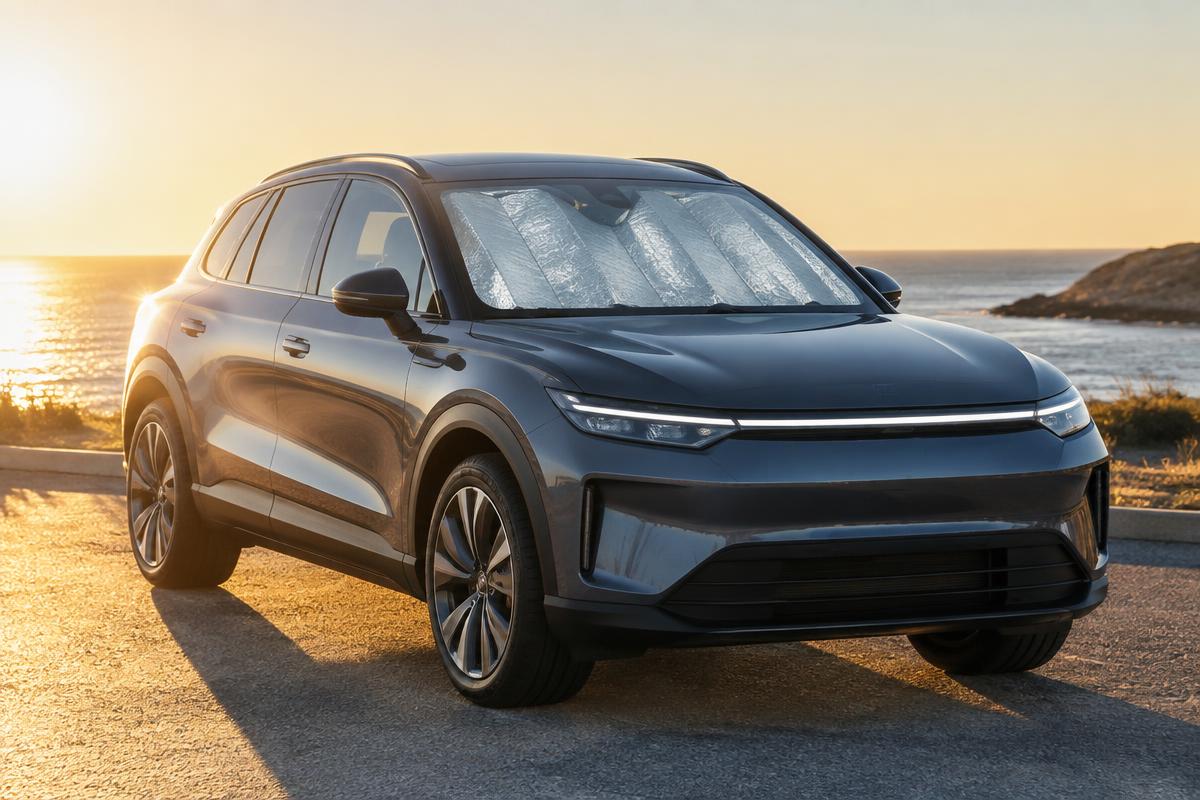
A Tesla Model Y has two large glass areas that admit light into the cabin: the windscreen and the fixed glass roof. Shading one and not the other leaves a substantial area uncovered, which is why three-piece sets exist.
Fitment is generation-specific for shaped shades. The 2025-2026 Model Y Juniper is treated as a separate fitment target from 2020-2024 cars, and several Juniper sets state they are not compatible with earlier Model Y.
EV Gear Lab does not publish cabin temperature figures. Heat and UV numbers on shade listings are seller statements, and real-world effect depends on climate, parking orientation and how long the car sits.
Fitment snapshot
- Vehicle
- Tesla Model Y, 2020-2024 and the 2025-2026 Juniper refresh
- Two separate glass areas
- Front windscreen and the fixed glass roof, which usually need different products
- Generation sensitivity
- Shaped Juniper roof shades are commonly stated as not fitting earlier Model Y
- Source of fitment claims
- Seller listing statements, recorded against each product in the EV Gear Lab catalogue
What to check before buying
- Decide whether you want windscreen coverage, roof coverage, or both as a matched set.
- Confirm whether your car is a Juniper (2025-2026) or an earlier Model Y before ordering a shaped shade.
- Check the storage format: framed panels fold, but three pieces take more boot space than one.
- Look at how the shade is retained — visors, suction, or a frame tucked under the roof trim.
- Price and stock live on Amazon. EV Gear Lab does not publish prices or ratings.
Last reviewed by EV Gear Lab on September 23, 2026. Fitment statements come from the compatibility records stored for each product; assessments are EV Gear Lab editorial judgement and are kept separate from manufacturer and marketplace listing claims.
The Model Y's glass roof is one of the nicest things about the car and the single biggest reason people buy shades for it. It makes the cabin feel enormous, and it also means that on a still summer afternoon the occupants are sitting beneath an uninterrupted sheet of glass. Add the steeply raked windscreen and you have two large apertures, both facing upward, both admitting light into an interior that is frequently black.
Sunshades are the low-effort answer. They are cheap, they require no modification, and they are the only accessory in this category you can fit and remove in under a minute. The difficulty is not choosing whether to have one; it is working out which of several near-identical-looking listings is actually cut for your car.
This guide separates the two coverage areas, explains why the Juniper refresh made this category more fitment-sensitive than it used to be, and sets out what a shade listing can and cannot honestly tell you.
Two glass areas, two different products
Most owners start with a windscreen shade, and for good reason: it covers the glass directly above the dashboard, which is where interior surfaces get the most direct exposure and where a parked car develops the sharpest heat gradient. A windscreen shade is also the least fitment-sensitive product in the category, because the aperture is bounded by the A-pillars and the visors give an obvious retention point.
The glass roof is a different problem. It is larger, it is above the occupants rather than in front of them, and it is typically covered by two shaped panels rather than one. Because those panels tuck under the roof trim and follow the curvature of the glass, they are cut for a specific car in a way a windscreen shade is not.
A three-piece set covers both areas with panels designed to work together. That is the practical argument for buying a set rather than assembling one: a windscreen shade from one seller and roof panels from another will do the job, but the edges will not relate to each other and you will have two storage bags instead of one.
- Windscreen shade: largest single contributor when the sun is in front of the car; least fitment-sensitive.
- Glass roof panels: largest total glass area; shaped and generation-specific.
- Three-piece sets: both areas covered by panels designed as a system.
- Rear side window shades are a separate category aimed at passenger comfort rather than parked-car coverage.
Why Juniper changed this category
Before the 2025 refresh, a shaped Model Y roof shade could reasonably claim a long year range, because the glass geometry stayed put. The Juniper refresh changed enough about the car that shade makers now cut separate parts, and the honest listings say so.
The JASVIC three-piece set in this catalogue is an example of that clarity: the seller states it is compatible with the Model Y Juniper 2025-2026 and explicitly not with earlier Model Y cars. That is more useful than a vague claim of universal Model Y fitment, because it tells you precisely when to buy it and when to look elsewhere.
A shade that is slightly the wrong size fails in a visible way. It will not tuck under the trim on one edge, it sags in the middle, and the reflective face ends up angled away from the glass rather than flat against it. That is the difference between a shade that looks fitted and one that looks improvised.
Construction: frames, fabrics and how they age
Almost every shade in this category uses a reflective outer face over a metal or sprung frame. The frame is not a luxury. It is what holds the panel flat against the glass so the reflective surface is doing its job across the whole area rather than only where it happens to touch.
The fabric layers vary in name more than in principle: reflective outer, an insulating middle layer, and a soft inner face so the panel does not mark trim. Sellers give these layers proprietary names, and those names are marketing rather than specification.
What actually determines whether you keep using a shade is how it behaves after a year of being twisted into a bag. A frame that takes a permanent set will no longer lie flat, and a shade that will not lie flat stays in the boot. Twist-folding the same way each time, rather than improvising, is the single habit that extends a shade's usable life.
- Framed panels sit flat against curved glass; frameless ones tend to sag at the edges.
- Layer names are marketing terms, not measured specifications.
- Consistent twist-folding prevents the frame taking a permanent set.
- Store the bag where it is easy to reach, or the shade stops being used.
What a shade listing can and cannot prove
Shade listings are full of temperature numbers. Some quote a cabin reduction in degrees, others a percentage of UV or infrared blocked. Those are seller figures, produced under unstated conditions, and they are not reproducible by a buyer.
That is why this site publishes fitment and construction detail but no thermal performance claims. What a listing can prove is what the product is: how many pieces, what shape, which cars it was cut for, how it is retained. Those are checkable, and they are what determines whether you are happy with the purchase.
What a shade genuinely does is uncontroversial without needing a number attached: it blocks direct light onto the dashboard, seats and console, and it keeps the cabin dimmer. Whether that is worth it depends on where you park, not on a figure in a listing.
Related Tesla models
Related guides
Common mistakes
- Buying a shaped Juniper roof shade for a 2020-2024 Model Y, or the reverse.
- Covering the windscreen only and wondering why the cabin still feels bright.
- Choosing a frameless shade for curved roof glass and accepting the sag.
- Treating a seller's degree figure as a measured specification.
- Buying a three-piece set without checking there is boot space for the bag.
- Folding the frame a different way each time until it no longer lies flat.
Multi-model windscreen shades
Not every shade is cut for one car. Windscreen shades are the least generation-sensitive product in the category, because the aperture is bounded by the A-pillars and the visors give an obvious retention point, so several sellers list a single panel across Model 3, Model S, Model X and Model Y.
That breadth is genuinely useful for a two-Tesla household, or for owners who want one shade that moves between cars. It is less useful if you want an edge-to-edge fit, because a panel sized to work across several windscreens is necessarily a compromise on all of them.
The practical test is the same one that applies to any shade: does it sit flat against the glass across its whole area, and does it fold back into its bag without being wrestled. A panel that does both will be used; one that does neither ends up in the garage.
Related accessories
Related guides
Conclusion
Sunshades are among the cheapest accessories a Model Y owner can buy and among the most used, provided the product is cut for the right car and stores somewhere reachable. Those two conditions decide the outcome far more than any material claim in a listing.
Work out which glass you actually need covered, confirm whether your car is a Juniper or an earlier Model Y, and buy a set whose listing states that generation explicitly. Then check the storage bag fits where you will realistically keep it, because the best shade is the one that does not live in the garage.
Frequently asked questions
Does a Tesla Model Y need a roof shade as well as a windscreen shade?
It depends on how the car is parked and for how long. The windscreen is the largest single contributor when the sun is ahead of the car, but the fixed glass roof is a very large area directly above the occupants and is the one people notice when the car sits all day in an open lot.
Do 2020-2024 Model Y sunshades fit the 2025-2026 Juniper?
Not reliably. Some windscreen shades state coverage across both, but shaped roof panels are commonly sold as Juniper-only, and several Juniper sets state directly that they do not fit earlier Model Y.
How much cooler does a sunshade make the cabin?
We do not publish a figure. Temperature claims on shade listings are seller statements rather than independent measurements, and the real effect varies enormously with climate, parking orientation, glass tint and time parked.
What is the difference between a framed shade and a folding one?
A framed panel holds itself flat against the glass so the reflective surface works across its whole area. A frameless folding shade is easier to store but tends to sag away from curved glass at the edges.
Where do sunshades go when they are not in use?
Framed panels twist-fold into a fabric bag, usually stored in the boot or sub-trunk. Three-piece sets need more room than a single windscreen shade, which is worth checking against how you actually use your boot.
Will a sunshade stop the glass roof leaking heat in winter?
A shade is a light and glare product. Any insulating effect is incidental and not something this site makes claims about.
How EV Gear Lab works: we research Tesla and EV accessories, record the fitment each product states, and publish our own assessment of how useful it is. Fitment and specification statements come from the product's stored record and the manufacturer listing; the buying judgement is EV Gear Lab editorial opinion. We do not sell these products — purchase links go to Amazon.
More guides
- Best Tesla Accessories for Model 3 & Model Y
- Tesla Model Y Juniper Accessories Worth Buying First
- Tesla Model Y Accessories: The Complete Buyer's Guide
- Best Floor Mats for Tesla Model Y: How to Choose
- Tesla Model 3 Accessories Worth Buying First
- Tesla Charging at Home: Cables, Holders and Setup
- Tesla Dashcam and Sentry Mode Storage Explained
- Tesla Winter Driving: Protection and Cabin Gear
- Tesla Interior Organization: Console, Frunk and Trunk
- How to Check Tesla Accessory Fitment by Model and Year
- Tesla Road Trip Accessories: What to Pack and What to Skip
- Tesla Pet Travel Accessories: A Practical Guide for Dogs and Cats
- Tesla Model Y Adapter Guide: J1772, NACS & Charging Adapters
- 2026 Tesla Model 3 16-Inch Screen: Fitment Guide
- Tesla Model Y Cabin Air Filter: HEPA Replacement Guide
- Tesla Jack Pads and Lifting Pucks: Fitment and Safe Use
- Tesla Model Y Mattress Guide: Camping and Sleeping Setup
- Tesla Model Y Fridge and Cooler Guide: Frunk, Console and Trunk
- Tesla USB Hub and Cabin Charging Guide: Model Y and Model 3
- Tesla Model S and Model X Accessories: Protection and Shading
- Tesla Cybertruck Bed Mat Guide: Protecting the Vault
- Tesla Model 3 Highland Floor Mats and Interior Protection