Short answer
Tesla jack pads are adapters that sit in the sill lift point so a jack saddle loads the designated structure instead of the battery pack enclosure beside it. They are among the few Tesla accessories that are genuinely not optional if you ever raise the car.
Post diameter is the fitment variable that matters. Two sizes are common, roughly 18 mm and 23 mm, and the wrong one either will not seat or sits loose.
The best-documented exception in the category: 2022-2023 Texas-built Model Y cars with the 4680 pack are stated by at least one seller to need the smaller 18 mm post rather than the standard 23 mm.
Fitment snapshot
- Applies to
- Tesla Model 3, Model Y, Model S and Model X
- Fitment variable
- Lift point post diameter, commonly 18 mm or 23 mm
- Known exception
- 2022-2023 Texas-built Model Y with the 4680 pack: one seller states the 18 mm post version is required
- Source of fitment claims
- Seller listing statements, recorded against each product in the EV Gear Lab catalogue
What to check before buying
- Measure your lift point hole diameter before ordering, especially on a Model Y.
- Buy four, not one — a two-post lift and most tyre shops need all four points.
- Check whether the listing publishes a model-year range at all; several do not.
- Juniper owners: look for a listing that states 2025-2026 rather than one that stops at 2024.
- Jack pads are not jack stands. Budget for stands separately if you intend to work under the car.
Last reviewed by EV Gear Lab on September 23, 2026. Fitment statements come from the compatibility records stored for each product; assessments are EV Gear Lab editorial judgement and are kept separate from manufacturer and marketplace listing claims.
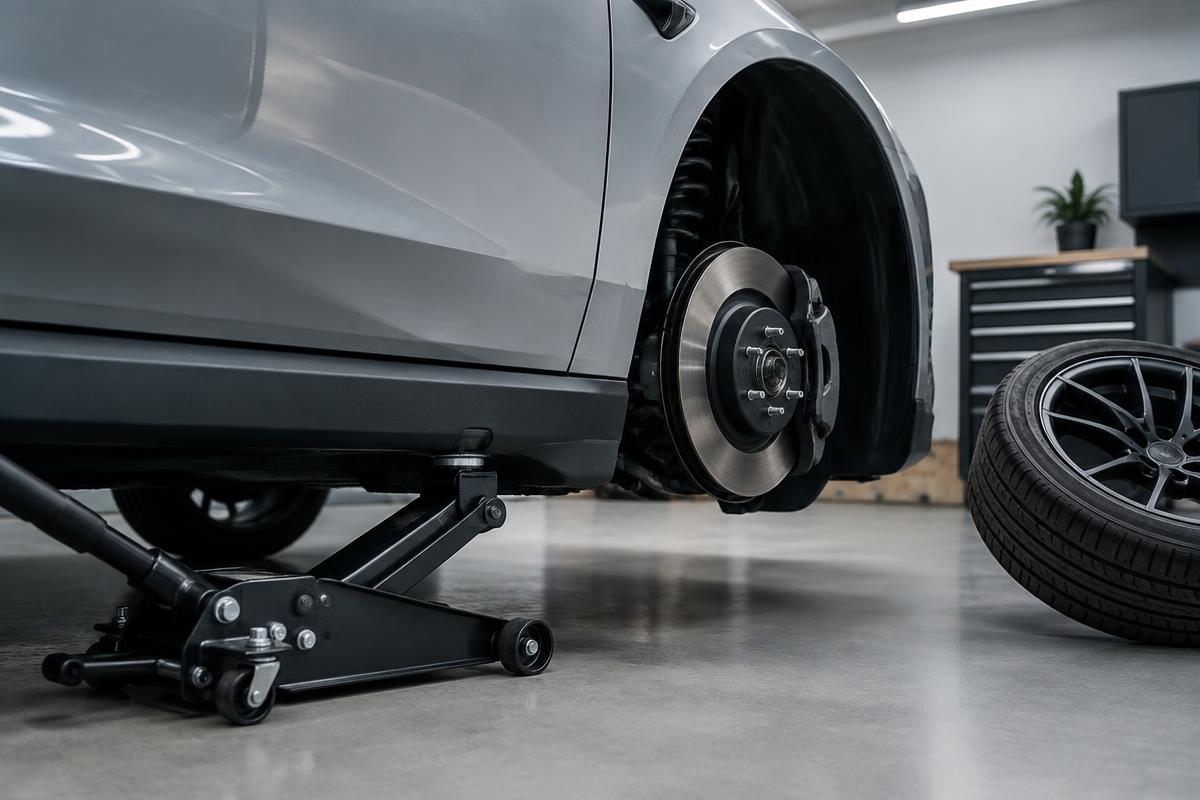
Lifting a Tesla is not conceptually different from lifting any other car, but the consequences of getting it wrong are. The battery pack sits under the floor, forming part of the structure, and the designated lift points on the sills are immediately adjacent to it. Place a jack saddle a couple of centimetres out and the load path runs through pack enclosure rather than through the reinforcement that was designed for it.
Jack pads exist to make that mistake harder. Each one is a puck with a post that locates into the sill lift point hole, giving the jack a broad, flat, correctly positioned surface to push against. They cost very little and they remove an expensive failure mode entirely, which is why they are the first thing to buy before the first tyre rotation rather than after the first mistake.
This guide covers what the pads do, how the two post sizes differ, how to read a fitment claim in a category where sellers are inconsistent about publishing one, and the procedure for using them safely.
What a jack pad actually protects
The lift point on a Tesla sill is a reinforced location with a hole in it. That hole is what a pad's post locates into, and it is also what makes a bare jack saddle dangerous: the saddle bridges across the hole and loads the thin material around it, or slides sideways under load onto structure that is not reinforced at all.
A pad solves three problems simultaneously. It spreads the load across the whole reinforced area rather than a saddle-sized patch. It locates the jack positively, so the car cannot creep sideways as it rises. And it puts a compliant material between steel and the vehicle, so a small misalignment deforms rubber or nylon rather than the car.
None of that is exotic engineering. It is simply the difference between a hundred-dollar accessory and a repair to a structural battery enclosure.
Post diameter: the one number that decides fitment
Most jack pad listings talk about material, rating and case quality. The variable that actually determines whether the product works on your car is the diameter of the locating post, and it is often buried in the specification table.
Two sizes dominate the aftermarket: roughly 0.7 inches, or 18 mm, and roughly 0.9 inches, or 23 mm. The 23 mm size covers the broad majority of Tesla builds. The 18 mm size exists because some builds have a smaller lift point hole, and a 23 mm post simply will not enter it.
The clearest published example of that split concerns the Model Y. One seller in this catalogue states that its 23 mm version covers 2016-2026 Model 3, Y, S and X including the Model Y Juniper, and then excludes 2022-2023 Texas-built Model Y vehicles with the 4680 pack, directing those owners to the 18 mm version instead. That is a more precise statement than most of the category manages, and it describes exactly the scenario owners run into: a pad that fits one Model Y perfectly and refuses to seat in another.
If you are unsure, measure. A tape measure across the hole takes ten seconds and settles the question better than any listing.
- 23 mm / 0.9 in post: the common size across most Tesla builds.
- 18 mm / 0.7 in post: required where the lift point hole is smaller.
- 2022-2023 Austin-built Model Y with 4680 pack: one seller states 18 mm is needed.
- A loose pad is as much a problem as one that will not fit — it can tilt under load.
Rubber pucks versus nylon spring-lock pads
The traditional design is a single moulded rubber puck with an O-ring around the post. The O-ring provides friction so the pad stays in the hole while you slide the jack underneath. It is simple, cheap and effective, and its weakness is entirely predictable: rubber rings stretch. After enough cycles the pad starts dropping out at the worst moment, which is usually when you are lying on a cold floor.
The newer approach replaces the O-ring with a sprung retention element in a reinforced nylon body. Nylon resists abrasion and garage-floor solvents better than soft rubber and does not carry the rubber smell, and a spring leaf does not lose tension the way an elastic band does.
Neither design is wrong. A rubber set with deep buyer history is a perfectly sound purchase, and replacement O-rings are trivial. The nylon sets are worth the attention mainly because, in this category, they tend to come with the clearest fitment statements.
Jack pad sets in this catalogue
Reading fitment claims in a category that often omits them
Jack pads are unusual among Tesla accessories in that many sellers describe compatibility by model name only — Model 3, Y, S, X — with no year range at all. That is not automatically a red flag, because the lift point design is stable across most builds, but it does shift the verification burden onto you.
Where a listing publishes no year range, this catalogue records the fitment as verify before buying rather than as confirmed. That is not a criticism of the product; it is an accurate description of what the evidence supports. The Chirano set falls into that group, and is included because it carries by a wide margin the deepest buyer feedback of any listing reviewed in this category.
Where a listing does publish a range, take it literally in both directions. A set stated as 2016-2024 is not making a claim about the 2025-2026 Juniper, and this site will not make one on its behalf. Juniper owners should choose a set whose listing states 2025 and 2026 explicitly.
Related Tesla models
Related guides
Using them safely
Work on level, solid ground. A sloped driveway is the single most common contributor to a lifting incident, and no accessory compensates for it.
Press each pad into the lift point until the retention holds it, then check it is sitting square rather than cocked at an angle. Bring the jack saddle up until it just contacts the flat base of the pad, then stop and look: the saddle should be centred and parallel, not touching at one edge. Only then raise the car, and do it slowly.
Once the car is at height, put stands under it before any part of you goes underneath. This is the part of the procedure that people skip and it is the part that matters. A jack is a lifting device, not a supporting one, and jack pads change nothing about that distinction.
Lower the car in the same deliberate way, remove the pads, and put them back in their case. A four-piece set that lives loose in the boot becomes a three-piece set surprisingly quickly.
- Level, solid ground only.
- Seat the pad square and confirm before loading.
- Saddle centred and parallel to the pad base.
- Stands under the car before anyone goes beneath it.
- Pads back in the case after every use.
Common mistakes
- Buying one pad instead of four, then discovering a lift needs all four points.
- Ordering a 23 mm post for a car whose lift point hole takes 18 mm.
- Assuming a set stated as 2016-2024 covers a 2025-2026 Juniper.
- Loading the jack before checking the pad is seated square.
- Treating the pads as though they support the car.
- Leaving pads permanently in the lift points where they collect road grit.
Conclusion
Jack pads are cheap insurance against an expensive and entirely avoidable mistake. If you rotate your own tyres, carry a jack, or expect to visit a tyre shop that does not have Tesla tooling on the wall, a set of four in a case belongs in the car.
Get the post diameter right, prefer a listing that states your model year explicitly, and remember the division of labour: pads decide where the load goes, stands decide whether the car stays up.
Frequently asked questions
Why does a Tesla need jack pads at all?
The battery pack enclosure runs beneath the floor, close to the designated sill lift points. A bare jack saddle placed slightly off the lift point, or hard against it without an adapter, concentrates the car's weight on structure not designed to carry it.
What size are Tesla jack pad posts?
Two sizes are common in the aftermarket, around 18 mm and around 23 mm. Which one your car takes depends on the build, so measuring the lift point hole is the reliable way to decide.
Which Model Y needs the smaller 18 mm pad?
One seller in this catalogue states that 2022-2023 Texas-built Model Y vehicles with the 4680 pack require the 18 mm post version rather than the 23 mm. If your car matches that description, measure before ordering.
How many jack pads should I buy?
Four. A two-post lift uses all four points simultaneously, and keeping a set of four in the car means any tyre shop without Tesla-specific tooling has what it needs.
Can I leave jack pads in the lift points permanently?
They are designed to be fitted for the lift and removed afterwards. Retention is there to hold the pad while you position the jack, not to make it a permanent fixture.
Are jack pads a substitute for jack stands?
No. A pad changes where load is applied; it does nothing to hold the car up. Never work beneath a vehicle supported only by a jack.
How EV Gear Lab works: we research Tesla and EV accessories, record the fitment each product states, and publish our own assessment of how useful it is. Fitment and specification statements come from the product's stored record and the manufacturer listing; the buying judgement is EV Gear Lab editorial opinion. We do not sell these products — purchase links go to Amazon.
More guides
- Best Tesla Accessories for Model 3 & Model Y
- Tesla Model Y Juniper Accessories Worth Buying First
- Tesla Model Y Accessories: The Complete Buyer's Guide
- Best Floor Mats for Tesla Model Y: How to Choose
- Tesla Model 3 Accessories Worth Buying First
- Tesla Charging at Home: Cables, Holders and Setup
- Tesla Dashcam and Sentry Mode Storage Explained
- Tesla Winter Driving: Protection and Cabin Gear
- Tesla Interior Organization: Console, Frunk and Trunk
- How to Check Tesla Accessory Fitment by Model and Year
- Tesla Road Trip Accessories: What to Pack and What to Skip
- Tesla Pet Travel Accessories: A Practical Guide for Dogs and Cats
- Tesla Model Y Adapter Guide: J1772, NACS & Charging Adapters
- 2026 Tesla Model 3 16-Inch Screen: Fitment Guide
- Tesla Model Y Cabin Air Filter: HEPA Replacement Guide
- Tesla Model Y Sunshade Guide: Windscreen and Glass Roof
- Tesla Model Y Mattress Guide: Camping and Sleeping Setup
- Tesla Model Y Fridge and Cooler Guide: Frunk, Console and Trunk
- Tesla USB Hub and Cabin Charging Guide: Model Y and Model 3
- Tesla Model S and Model X Accessories: Protection and Shading
- Tesla Cybertruck Bed Mat Guide: Protecting the Vault
- Tesla Model 3 Highland Floor Mats and Interior Protection