Short answer
A Model Y cooler is chosen by where it fits before it is chosen by capacity. The three practical locations are the front trunk, the rear side-trunk recess and the rear centre console gap, and each takes a different shape of product.
Two cooling technologies appear in this category. Compressor fridges work like a domestic refrigerator and are the type used for larger built-in units. Thermoelectric (semiconductor) coolers are smaller, simpler and used for console-sized products that also warm.
EV Gear Lab does not publish cooling temperatures, power draw figures or runtime claims. Those numbers are seller statements, and they depend on ambient temperature, how full the unit is and how often it is opened.
Fitment snapshot
- Vehicle
- Tesla Model Y, 2020-2026 depending on the product
- Placement options
- Front trunk, rear side-trunk recess, rear centre console gap
- Seat layout
- The side-trunk recess product in this catalogue is recorded for five-seat cars only
- Generation sensitivity
- Console-fitted units are Juniper-specific; load-area units depend on measured space rather than model year
What to check before buying
- Decide the location first — frunk, side-trunk recess or rear console — then filter by size.
- Measure the recess or gap you intend to use, including depth and any lip or trim.
- Confirm your seat layout: a five-seat Model Y and a seven-seat car do not have the same rear storage.
- Check what power lead the seller supplies and which outlet you intend to run it from.
- Read the capacity in litres as a volume, not as a number of cans; shape decides what actually goes in.
- Price and stock live on Amazon. EV Gear Lab does not publish prices or ratings.
Last reviewed by EV Gear Lab on September 23, 2026. Fitment statements come from the compatibility records stored for each product; assessments are EV Gear Lab editorial judgement and are kept separate from manufacturer and marketplace listing claims.
Cold storage is one of the few accessory categories where the Model Y has a genuine advantage over a comparable combustion SUV. There is a sealed, separately accessible front trunk, there are moulded recesses in the rear load area, and there is a car that is happy to supply accessory power without an engine running.
The confusion in this category is that three very different products get filed under the same search term. A 35-litre compressor fridge, a 16-litre unit that mounts into the rear side recess and a 3.6-litre cooler shaped for the rear console gap are not competing with each other. They solve different problems, in different places, for different trips.
This guide separates them by placement, explains what compressor and thermoelectric cooling mean in practice, and sets out the fitment and power questions to settle before ordering. It does not quote cooling temperatures or power figures, because those numbers on listings are seller statements rather than measurements.
Start with placement, not capacity
Capacity is the number listings shout about and the least useful one to shop by first. A 35-litre fridge that does not fit the space you intended is worse than a 16-litre one that disappears into a recess you were not using efficiently.
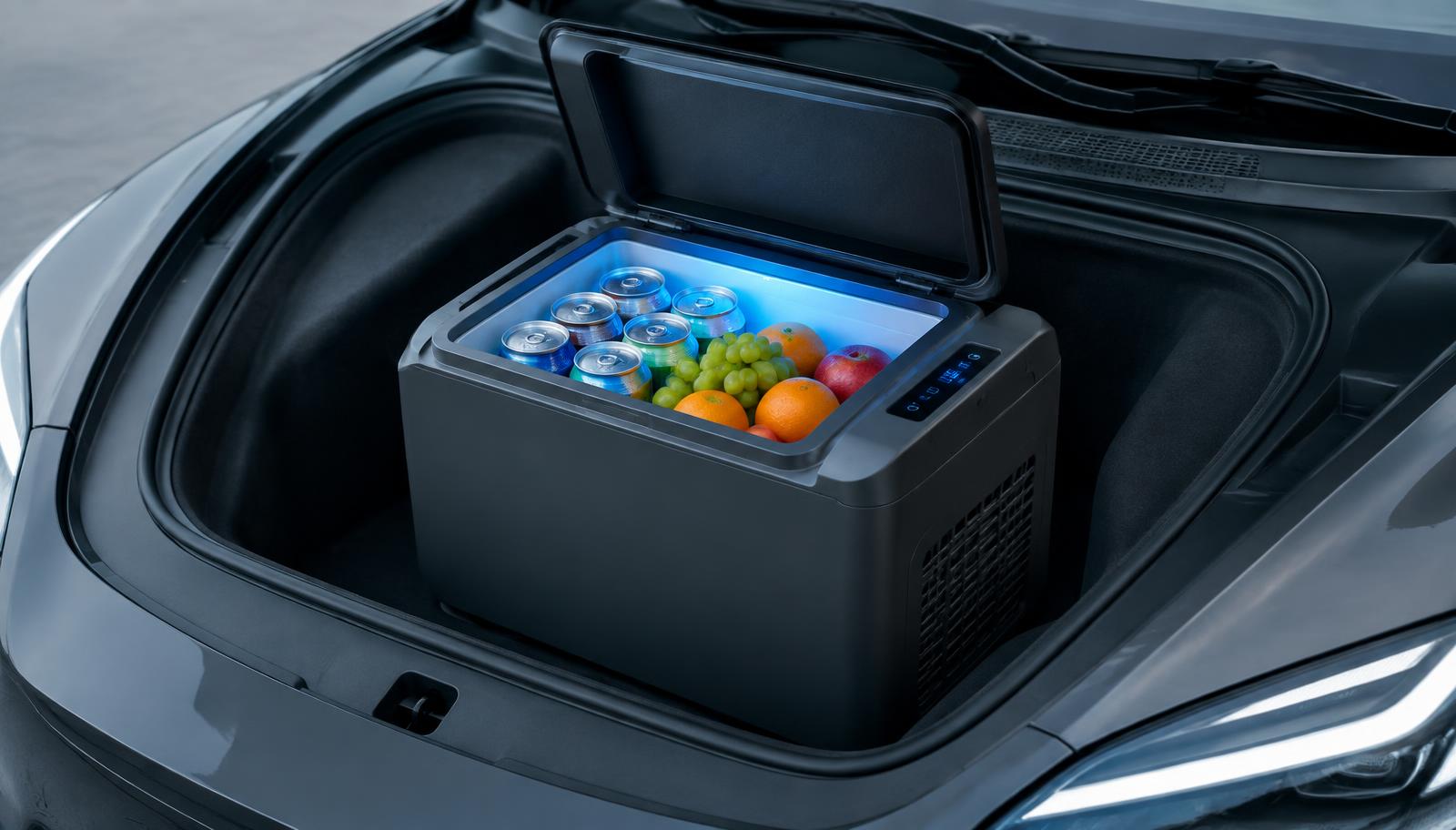
The front trunk suits a portable compressor fridge. It is enclosed, it is separate from the luggage, and food and drink stored there never migrate into the main boot. The trade-off is blunt: a fridge of any real capacity occupies most of the frunk, so the frunk stops being general storage.
The rear side-trunk recess is the tidiest option for owners who want cold storage permanently installed without losing the main boot floor. It only exists in usable form on five-seat cars, which is why the product recorded in this catalogue for that location states five-seat fitment.
The rear centre console gap is a different proposition again. It is small, it is between the rear passengers, and it is space almost nobody was using productively. A unit shaped for that gap adds cold storage without taking anything away, which is the argument for it.
- Front trunk: best for portable compressor fridges; costs you the frunk as general storage.
- Rear side-trunk recess: tidiest permanent install; recorded here for five-seat Model Y only.
- Rear centre console gap: smallest capacity, smallest compromise; Juniper-specific shaping.
- Main boot floor: possible for any portable unit, but it moves around and blocks the load area.
Compressor and thermoelectric cooling: what the words mean
A compressor fridge uses the same refrigeration cycle as the appliance in your kitchen. It is the technology used by the larger units in this category, including the 35-litre built-in format and the 16-litre side-trunk unit, and it is what makes app control, mode switching and a set temperature meaningful features rather than decoration.
A thermoelectric or semiconductor cooler moves heat across a solid-state junction instead. There is no refrigerant circuit and no compressor, which makes the unit smaller, mechanically simpler and able to run in reverse to warm rather than cool. That reversibility is why the console-sized product in this catalogue is described as a cooler and warmer.
The honest summary is that compressor units are the serious option for keeping food cold on a long trip, and thermoelectric units are the convenient option for keeping a few drinks cool on a short one. We are not publishing temperatures for either, because the figures printed on listings are seller claims that we have not measured.
Model Y coolers and fridges in this catalogue
The three products and what each is recorded for
The BODEGACOOLER 35-litre unit is a compressor fridge in a built-in format with app control, listed for 12/24 V DC and mains AC operation. Its compatibility record is Model Y with a verify-before-buying status, and it notes that Juniper is not separately stated by the seller. In practice this is a measurement question: work out where in the load area or frunk it will sit and check the external dimensions against that space.
The TEMAI 16-litre unit is the permanent-install option. It is a compressor fridge that mounts into the rear side trunk recess, and the catalogue records it for Model Y 2020-2025, five-seat only. If your car is a seven-seat Model Y, that recess is not the same and the product does not apply to you.
The Tlyard 3.6-litre unit is the console option: a thermoelectric cooler and warmer shaped for the Model Y Juniper rear centre console gap, recorded for 2025-2026 Juniper. The seller shapes it for that specific console, so the sensible check is to confirm the gap dimensions on your own car, which the product's buying notes say directly.
Power: what to settle before ordering
Every product in this category needs a supply, and the differences are in the lead and the outlet rather than in anything exotic. Larger compressor units commonly accept both DC from the car and AC from mains, which is useful because it lets you pre-cool the unit at home rather than asking the car to do the initial pull-down on the move.
Check which lead is actually in the box. Sellers ship different combinations, and a unit that arrives with a plug that does not match the outlet you planned to use is a delay rather than a disaster, but an avoidable one.
Think about what happens when the car is parked and locked. Accessory power behaviour varies with the car's settings and software, and the practical answer for your own vehicle is something to establish by testing a short parked period before relying on the unit to keep food cold overnight. We do not publish runtime or consumption estimates.
Finally, route the cable so the boot or frunk still closes cleanly and nothing is pinched. A permanently installed side-trunk unit makes this easier than a portable one, which is part of what you are paying for.
Juniper versus earlier Model Y
For load-area products, the Juniper refresh matters less than people expect. A portable fridge sitting in the frunk or the boot is constrained by measured space, not by badge, which is why the 35-litre unit is recorded against Model Y generally with a verify-before-buying status rather than against a year range.
For anything shaped to the interior, the refresh matters a great deal. The rear console gap is the clearest example: a unit moulded for the Juniper console is moulded for that console, and the earlier car is a different shape. The catalogue records that distinction rather than smoothing it over.
The side-trunk unit sits between the two. It mounts into a recess, so it is shape-dependent, and the seller's stated coverage runs 2020-2025 on five-seat cars. If you have a 2026 car or a seven-seat layout, that is a question for the seller rather than an assumption to make.
Related Tesla models
Common mistakes
- Shopping by litres before deciding which space the unit will occupy.
- Assuming a rear-console unit shaped for Juniper will fit an earlier Model Y console.
- Overlooking seat layout — the side-trunk recess product is recorded for five-seat cars.
- Buying a unit whose lid cannot fully open in the space you planned for it.
- Relying on a seller's quoted temperature or runtime figure as if it were a measurement.
- Losing the frunk entirely and then needing somewhere for charging cables and luggage.
Conclusion
Cold storage in a Model Y is a placement decision dressed up as a capacity decision. Work out whether you want the frunk occupied, a recess permanently filled or the rear console gap used, and the choice between a 35-litre compressor unit, a 16-litre side-trunk install and a 3.6-litre console cooler mostly makes itself.
Then measure, confirm the seat layout and generation the listing actually names, and check which power lead is supplied. Those three checks prevent almost every returned order in this category, and none of them require trusting a number printed on a product page.
Frequently asked questions
Can you fit a fridge in a Tesla Model Y frunk?
Portable compressor fridges are commonly used in the front trunk because it is an enclosed, separately accessible space that keeps food away from luggage. Whether a specific unit fits is a question of measuring the frunk against the fridge's external dimensions, including the clearance the lid needs to open.
What is the difference between a compressor fridge and a thermoelectric cooler?
A compressor fridge uses a refrigeration cycle, which is the same principle as a kitchen fridge, and is the technology used in the larger built-in units. A thermoelectric or semiconductor cooler moves heat across a solid-state junction; the units are smaller, simpler and often also warm, which is why they suit console-sized products.
Where does a Model Y fridge get power?
From the car's 12 V accessory outlets or, for units that also accept mains, from AC when parked at home. The specific lead is supplied by the seller and differs between products, so confirm what is in the box and which outlet you intend to use before ordering.
Will a fridge drain the battery?
Any accessory left running draws energy, and how much depends on the unit, the ambient temperature and how long the car is parked. We do not publish consumption figures for these products because the sellers' numbers are not independently measured. Treat overnight unattended running as something to test on your own car rather than assume.
Does a rear console fridge fit a pre-Juniper Model Y?
The console unit in this catalogue is recorded for the Model Y Juniper 2025-2026 rear centre console, because it is shaped around that specific gap. The earlier Model Y console is a different shape, so the fit should not be assumed.
Do these products affect boot space?
Yes, and that is the main practical cost. A side-trunk unit occupies a recess you were probably already using, and a portable frunk fridge takes most of the frunk. The console unit is the only one that uses space most owners were not storing anything useful in.
How EV Gear Lab works: we research Tesla and EV accessories, record the fitment each product states, and publish our own assessment of how useful it is. Fitment and specification statements come from the product's stored record and the manufacturer listing; the buying judgement is EV Gear Lab editorial opinion. We do not sell these products — purchase links go to Amazon.
More guides
- Best Tesla Accessories for Model 3 & Model Y
- Tesla Model Y Juniper Accessories Worth Buying First
- Tesla Model Y Accessories: The Complete Buyer's Guide
- Best Floor Mats for Tesla Model Y: How to Choose
- Tesla Model 3 Accessories Worth Buying First
- Tesla Charging at Home: Cables, Holders and Setup
- Tesla Dashcam and Sentry Mode Storage Explained
- Tesla Winter Driving: Protection and Cabin Gear
- Tesla Interior Organization: Console, Frunk and Trunk
- How to Check Tesla Accessory Fitment by Model and Year
- Tesla Road Trip Accessories: What to Pack and What to Skip
- Tesla Pet Travel Accessories: A Practical Guide for Dogs and Cats
- Tesla Model Y Adapter Guide: J1772, NACS & Charging Adapters
- 2026 Tesla Model 3 16-Inch Screen: Fitment Guide
- Tesla Model Y Cabin Air Filter: HEPA Replacement Guide
- Tesla Jack Pads and Lifting Pucks: Fitment and Safe Use
- Tesla Model Y Sunshade Guide: Windscreen and Glass Roof
- Tesla Model Y Mattress Guide: Camping and Sleeping Setup
- Tesla USB Hub and Cabin Charging Guide: Model Y and Model 3
- Tesla Model S and Model X Accessories: Protection and Shading
- Tesla Cybertruck Bed Mat Guide: Protecting the Vault
- Tesla Model 3 Highland Floor Mats and Interior Protection